Tuesday, November 17, 2015

HABIB TANVIR

INTRODUCTION
Habib Tanvir (1 September 1923 – 8 June 2009)
  • He was one of the most popular Indian Urdu, Hindi playwrights, a theatre director, poet and actor. He was the writer of plays such as, Agra Bazar (1954) and Charandas Chor (1975). A pioneer in UrduHindi theatre, he was most known for his work with Chhattisgarhi tribals, at the Naya Theatre, a theatre company he founded in 1959 in Bhopal.
  • He went on to include indigenous performance forms such as nacha, to create not only a new theatrical language, but also milestones such as Charandas ChorGaon ka Naam Sasural, Mor Naam Damadand Kamdeo ka Apna Basant Ritu ka Sapna.
Biography
  • Born inRaipur, Chhattisgarh(erstwhile Madhya Pradesh) to Hafiz Ahmed Khan, who hailed from Peshawar.
  • He passed his matriculation from Laurie Municipal High School,Raipur, and later completed his B.A. from Morris College, Nagpur in 1944. Thereafter he studied M.A. for a year at Aligarh Muslim University.
  • Early in life, he started writing poetry using his pen nametakhalluz. Soon after, he assumed his name, Habib Tanvir.
Career
  • In 1945, he moved to Bombay,
  • ALL INDIA RADIO (AIR) Bombay as a producer
  • PROGRESIVE WRITER'S ASSOCIATION
  • INDIAN PEOPLE'S THEATRE ASSOCIATION (IPTA) AS AN ACTOR
  • he trained in Acting atRoyal Academy of Dramatic Arts (RADA) (1955)
Award & Achievements
  • Sangeet natak academy award-1969
  • Padamshree-1983
  • Padam vibhushan- 2002
  • Member of Rajyasabha- 1972 to 1978
Plays
  • Charandas Chor (1975)
  • Agra Bazar (1954)
  • Mitti ki Gaadi (1958)
  • Ponga Pandit (1960s)
  • The Broken Bridge (1995)
Habib Tanvir
Born Habib Ahmed Khan 1 September 1923 Raipur, Chhattisgarh
Died 8 June 2009 (aged 85) Bhopal, Madhya Pradesh
Occupation Playwright, dramatist, poet, actor
Years active 1945–2009
Spouse(s) Moneeka Mishra (1930–2005) Children = Anna (b.1964), Nageen (b. 1964)
Website habibtanvir.org
  SOME PICTURES OF PLAYS agra bazar 2 AGRA BAZAR     agra bazar        PONGA PANDIT Filmography
SOME VIDEOS OF HABIB TANVIR https://www.youtube.com/watch?v=6PYsyl4xBDA GANDHI 1982 MOVIE https://www.youtube.com/watch?v=hmU_W8ybLSE HERO HIRA LAL

BEGUM AKHTAR

INTRODUCTION

BEGUM AKHTAR (7 October 1914 – 30 October 1974)

sardarakhtarAkhtari Bai Faizabadi, also known as begum akhar  she was a well known Indian singer of Ghazal, and Dadra, and Thumri genres of Hindustani classical music.

Early life

Begum Akhtar was born in Bada Darwaza, Town Bhadarsa, Bharatkund, Faizabad District, Uttar Pradesh. Her father, Asghar Hussain, a young lawyer who fell in love with her mother Mushtari and made her his second wife, subsequently disowned her and his twin daughters Zohra and Bibbi (Akhtar)

Career

Akhtar was barely seven when she was captivated by the music of Chandra Bai, an artist attached to a touring theatre group. she travelled to Calcutta with her mother and learnt music from classical stalwarts like Mohammad Khan . Her first public performance was at the age of fifteen. The famous poetess, Sarojini Naidu, appreciated her singing during a concert which was organised in the aid of victims of the 1934 Nepal–Bihar earthquake. She cut her first disc for the Megaphone Record Company, at that time. A number of gramophone records were released carrying her ghazalsdadrasthumris, etc. She was amongst the early female singers to give public concert, and break away from singing in mehfils or private gatherings, and in time came to be known as Mallika-e-Ghazal (Queen of Ghazal) Beghum Akhtar acted in a few Hindi movies in the 1930s. East India Film Company of Calcutta approached her to act in "King for a Day" (alias Ek Din Ka Badshah) and Nal Damayanti in 1933. Like others of that era, she sang her songs herself in all her films. She continued acting in the following years. Subsequently Beghum Akhtar moved back to Lucknow where she was approached by the famous producer-director Mehboob Khan, as a result of which she acted in Roti which was released in 1942 and whose music was composed by maestroAnil Biswas. "Roti" contained six of her ghazals but unfortunately due to some trouble between producer and director, Mehboob Khan subsequently deleted three or four ghazals from the film. All the ghazals are available on Megaphone gramophone records. Begum Akhtar, meanwhile, left Bombay and returned to Lucknow. In 1945, Akhtaribai married a Lucknow-based barrister, Ishtiaq Ahmed Abbasi, and became known as Begum Akhtar.[8] However, after marriage, due to her husband's restrictions, she could not sing for almost five years and subsequently, she fell ill, that is when her return to music was prescribed as a befitting remedy, and in 1949 she returned to the recording studios.[9] She sang three ghazals and a dadra at Lucknow All India Radio station. She wept afterwards and returned to singing in concerts, a practice that lasted until her death. Though, she sang publicly in Lucknow, except for women's only concert in aid of the war, which was held in 1962.

Death

During her last concert in Ahmedabad she raised the pitch of her voice as she felt that her singing had not been as good as she had wanted it to be and she felt unwell. The additional demand and stress that she put herself under resulted in her falling ill and was rushed to the hospital. She died on 30 October 1974 . Hindi films
  • Naseeb Ka Chakkar
  • Roti | Anna Sahab Mainka
  • Panna Dai| Gyan Dutt
  • Dana Pani | Mohan Junior
  • Ehsaan

Filmography

  • Mumtaz Beghum (1934)
  • Jawaani Ka Nasha (1935)
  • King for a Day (1933, director : Raaj Hans)
  • Ameena (1934, director : -)
  • Roop Kumari (1934, director : Madan)
  • Naseeb Ka Chakkar (1936, director : Pesi Karani)
  • AnaarBala (1940, director : A M Khan)
  • Roti(1942, director : Maadhav Kaale)
  • Jalsaghar(1958; director: Satyajit Ray)

Awards and recognition

Bibliography

  • In Memory of Begum Akhtar, by Shahid Ali Agha. US Inter Culture Associates, 1979.
  • Begum Akhtar: The Queen of Ghazal, by Sutapa Mukherjee. Rupa & Co, 2005,ISBN 81-7167-985-4.
  • Begum Akhtar: The Story of My Ammi, by Shanti Hiranand. Published by Viva Books, 2005.ISBN 81-309-0172-2.
  • Begum Akhtar: Love’s Own Voice, by S. Kalidas. 2009.
ONE VIDEOS GHAZAL https://www.youtube.com/watch?v=46HnhCItoKg Ghazal - aaey kuch abr, kuch sharaab aaey

TARE ZAMEEN PAR

TARE ZAMEEN PAR
                     TZP
Director :             Aamir KhaN Cast       :             Aamir Khan, Tanay Chheda, Darsheel Safary, Tisca Chopra
INTRODUCTION:
Taare Zameen Par isn't one of those films that merely entertains, but also enlightens. Taare Zameen Par is one film that makes you peep into a child's mind and how some parents, in their pursuit to make them 'stronger' academically, forget that there's hitherto untapped talent that needs to be nourished and encouraged.
SUMMARY :
Ishaan Nandkishore Awasthi (Darsheel Safary) is an eight-year-old boy who dislikes school and fails every test or exam. He finds all subjects difficult, and is belittled and berated by his teachers and classmates. But Ishaan's internal world is rich with wonders that he is unable to convey to others, magical lands filled with colour and animated animals. He is an artist whose talent is unrecognised.
Ishaan's father, Nandkishore Awasthi (Vipin Sharma), is a successful executive who expects his children to excel. His mother, housewife Maya Awasthi (Tisca Chopra), is frustrated by her inability to educate her son. Ishaan's elder brother, Yohaan (Sachet Engineer), is an exemplary scholar and athlete, which Ishaan is frequently reminded of.
After receiving a particularly poor academic report, Ishaan's parents send him to a boarding school. There he sinks into a state of fear and depression, despite being befriended by Rajan (Tanay Chheda), physically disabled and one of the top students in his class.
Ishaan's situation changes when a new art teacher, Ram Shankar Nikumbh (Aamir Khan), joins the school's faculty. An instructor at the Tulips School for young children with developmental disabilities, Nikumbh's teaching style is markedly different from that of his strict predecessor, and he quickly observes that Ishaan is unhappy and contributes little to class activities. He reviews Ishaan's work and concludes that his academic shortcomings are indicative of dyslexia.
On his day off, Nikumbh sets off to Mumbai, to visit Ishaan's parents. Nikumbh is surprised to learn that Ishaan is passionate about painting, and shows great talent in art. Nikumbh then asks Mr Awasthi as to why he sent Ishaan to a boarding school. Mr Awasthi replies that Ishaan was an ill mannered boy and was a poor student. Nikumbh shows Ishaan's mother her son's notebooks and gives an analysis of the script. Nikumbh deduces that Ishaan has severe difficulty in understanding letters and words. Mr Awasthi tries to dismiss it as a mere excuse for Ishaan's laziness. Nikumbh demonstrates what Ishaan experiences every day at school. He states that Ishaan has dyslexia as well as he may be having other conditions, which make him a difficult child.
Mr Awasthi bluntly categorises it as mental retardation, but Nikumbh criticizes him. Nikumbh argues that Ishaan is an above average child and processes information differently. He further states that Mr Awasthi failed to understand Ishaan and as a result the latter is facing low self-esteem and no longer paints.
Nikumbh returns, and subsequently brings up the topic of dyslexia in class, and offers a list of famous people who were dyslexic. Later, Nikumbh reveals to Ishaan, that he too is a dyslexic and faced problems similar to Ishaan. Nikumbh then visits the school's principal and obtains his permission to become Ishaan's tutor. He attempts to improve Ishaan's reading and writing by using remedial techniques developed by dyslexia specialists; Ishaan soon develops an interest in language and mathematics, and his grades improve.
Towards the end of the school year Nikumbh organises an art fair for the staff and students. The competition is judged by artist Lalita Lajmi. Ishaan, with his strikingly creative style, is declared the winner and Nikumbh, who paints Ishaan's portrait, the runner-up. The principal announces that Nikumbh has been hired as the school's permanent art teacher. When Ishaan's parents meet his teachers on the last day of school they are left speechless by the transformation they see in him. Overcome with emotion, Ishaan's father thanks Nikumbh. As Ishaan is getting into the car to leave with his parents for summer vacations, he turns around and runs toward Nikumbh. The film ends with a freeze frame shot of Nikumbh tossing Ishaan into the air.
jyoti
Here we can see the main character of the film ishaan avasthi is facing a problem which is dyslexia. And his parent dont want to accept them and thats why they behave with ishaan as a normal kid. ishan's father behave with him very strictly. He pressurised him to give best result as his elder brother thats why he always give negative reinforcement to ishaan.
ROLE OF PARENTS:
parents of this type of child should have to accept their child and they should give so much love and care of their special child. They should try to understand their problems or situations. they should have to fullfill their needs according to child's problem like physically and mentaly.
ROLE OF TEACHERS:
In this film we can see how the teachers behave with ishaan,they behave very roudly and punished all the time. They always insulting him for his all mistakes.

SAADAT HASAN MANTO

INTRODUCTION
Saadat Hasan Manto Was a Pakistani Writer, Playwright and Author who is considered to be among the greatest writer of short stories in South Asian history.His career as a writer produced twenty-two collections of short stories, one novel, five series of Radio plays,three collections of Essay ,Two collections of Personal Sketches.
BIOGRAPHY
  • EARLY LIFE AND EDUCATION-Sadat Hasan Manto was born in paproudi village in ludhiana  district of the punjab in a kashmiri pandit family of barristers on 1.may.1912.
   The big turning point in his came in 1933, at age 21, when he met Abdul Bari Alig ,a Scholar and Polemic Writer in Amritsar.Alig encourage him to find his true talent and read Russian and French Authors.
  • EARLY CAREER
        Within a matter of months Manto produced an Urdu translation of victor Hugo`s The Last Day of a Condemned Man, which was published by URDU BOOK STALL, Lahore as Sarguzast-e-Aseer(A Prisoner,s Story).Soon afterwards he joined the editional staff of masawat, a daily published from ludhiana.
    This heightened enthusian pushed Manto to pursue graduation at ALIGARH MUSLIM UNIVERSITY.which he joined in february 1934, and soon got associated with INDIAN PROGRESSIVE WRITER’S ASSIOCIATED(IPWA). it was here that he met writers all sardar jafri and found a new sprit in his wrirting .Hiss second story ” INQLAAB PASAND” was publish in ALIGARH MAGAZINE in March 1935.
  Saadat Hasan Manto had accepted the job of writing for Urdu Service of  ALL INDIA RADIO in 1941.
BIBLIOGRAPHY
  •  ATISHPARAY..1936
  • MANTO KE AFSANE 1940
  • AFSANE AUR DRAMAY 1943
  • LAZZAT-E-SANG 1948
  • BADSHAHAT KA KHATIMAH 1950
https://www.youtube.com/watch?v=vNmrMETP42o&feature=youtu.be

Mindfulness In Classroom

     INTRODUCTION

mindfulness
  • Mindfulness in the classroom, sometimes called “contemplative pedagogy,” involves teaching methods designed to cultivate deepened awareness, concentration, and insight.
  • Mindfulness involves paying attention “on purpose”. Mindfulness involves a conscious direction of our awareness. Mindfulness is an emotionally non-reactive state. We don’t judge that this experience is good and that one is bad. Or if we do make those judgements we simply notice them and let go of them.
IMG_2675
  • The workshop under this concept was provided to us by S. Sharma on 21st of October
  • Cultivation of mind is the aim of the activity, it is required so that child’s mind should be able to cultivate a capacity for awareness and concentration. Such methods include meditation, silence, music, art and questions.
  • Its purpose is to develop non judgemental attitude and not to get disturbed easily by things which are not as per our planning and concepts.
  • It also means to accept ourselves completely, acceptance means acknowledging what you’re feeling, and standing back from it so that although you experience the unpleasant emotion you don’t entirely define yourself by it.
IMG_2691 Please find the link below which shows activities for students. https://www.youtube.com/watch?v=lGob      Brief about Workshop IMG_2677 Our institute organised a workshop on “mindfulness in the classroom” on september 24 2015 . Yoga and meditation were taught in our workshop. Three asanas in yoga were taught by Mr.S Sharma they were 1. Kapalbhati 2. Anuloma Viloma 3. Padaamasana Activities during Workshop KAPALBHATI kapalbhati-pranayam The process of kapalbhati is related to the breathing process, however it is not a type of pranayam. But, certain sadhakas think in this manner and study kapalbhati under the impression that they are studying a type of pranayam. However, process of cleaning the wind pipe is one of the shuddhikriyas. The word kapalbhati is made up of two words, kapal meaning skull ( here skull includes all the organs under the skull too ) and bhati means shining, illuminating. Due to the process, the organs under the skull mainly the brain and the small brain are influenced in a good manner. Hence the word is used in that way. IMG_2694 A cycle or rotation of Kapalbhati should be performed as follows :
  • Keep breathing gradually while sitting in Padmasana. o Inhale and start performing Kapalbhati as stated before. That means a strong Rechaka, natural Pooraka and again strong Rechaka and natural pooraka. • Keep on doing this rotation swiftly in rhythmic manner. • Perform as many cycles as possible and then keep breathing gradually. All these processes are included under one cycle of Kapalbhati. Please find link for the Kapalbhati asana https://www.youtube.com/watch?v=1d3erUbB3uw

2.Anuloma viloma

3995584_orig Anulom Vilom Pranayama or alternate nostril breathing exercise is one of the main practices of Pranayama. Anulom Vilom Pranayama is mentioned in the yogic texts Hatha Yoga Pradeepika, Gheranda Samhita, Tirumandiram, Siva Samhita, Puranas and in the Upanishads.
  1. Anulom Vilom Pranayama cleans the pranic channels and makes the prana flow freely in the entire body. The nadis or the pranic energy channels are purified. Hence this pranayama is also called Nadi Shodhana Pranayama. 2. Purification of the energy channels ensures proper supply of pranic energy to all the organs enhancing the overall health of the body. 3. Anulom Vilom Pranyama balances the two main energy channels –Ida and Pingala. It balances the two hemispheres of the brain, bringing about peace and tranquility. 4. When the Ida and Pingala nadis are balanced, it awakens the central channel called Sushumna Nadi. 5. It removes toxins from the body. 6. Prolonged practice of Anulom Vilom Pranayama leads to next stage of yoga, which is Pratyahara or withdrawal of the senses. This enables the practitioner to progress towards higher practices ofDharana, Dhyana and Samadhi. 7. It can reduce weight in some practitioners depending on their body constitution and is a good practice for obesity.
IMG_2695 Please find link for the anulom vilom asana https://www.youtube.com/watch?v=x2L4KP7xpfY

3.Padamasana

main-qimg-7ed03fde15245cef91a8be2cc11dd91e Padmasana or the Lotus Pose is an important meditative asana and is mentioned in most yogic texts. In Sanskrit, ‘Padma’ means lotus and ‘Asana’ means pose. Padmasana is mentioned in the yogic text Hatha Yoga Pradeepika, as one of the main asanas for meditation that can destroy all diseases. If you see the drawings and sculptors of ancient yogis, you will notice that they are seated in Padmasana. Ancient statues of Shiva, Buddha and Mahavira are all depicted as sitting in Padmasana. The hand mudras may vary, but the legs are always shown seated in the lotus pose. IMG_2693 Padmasana is not easy for beginners. In the eastern traditions, people are used to sitting on the floor in the simple cross legged position, especially for meals. But in the western tradition, most people use the chair for sitting and for meals. In such cases, a little practice will be required to bring flexibility into the legs. One can do any exercise that stretches the lower legs, thigh and waist muscles to get this flexibility. Also the joints (ankles, knee and waist) should be made supple by doing Pawanmuktasana series of exercises. Those suffering from sciatica and sacral pain, weak knee joints, etc. should avoid this asana. IMG_2692 Please find link for the Padamasana https://www.youtube.com/watch?v=JUHOedjFHCg Importance of Yoga and meditation in student’s life
  • De stress: One of yoga’s primary benefits for adults is the alleviation of stress. Students may be young, but they aren’t immune to stress. Family pressure, financial fears, academic performance standards and peer groups can all take a toll on a student’s psyche and success in school.
  • Enhanced Body Image: Students often struggle with poor body image and awkwardness of movement. A study published in “Explore” in the summer of 2013 found that high-school students who practiced yoga instead of regular physical education for a semester, reported better kinesthetic awareness — the sense of how your body moves through space — and more respect for their own bodies.
  • Improve Concentration: Yoga offers time for the body and mind to relax from the rigors of learning. This may help students be better at applying themselves when studying or learning in a classroom. Medical students who practiced yoga for just one month reported better sleep and improved concentration during their studies outcome.
IMG_2690 From this workshop my perspective on yoga has totally changed now i am able to realise that how yoga is important in an individual life, to lead a better and healthy life , as in todays life everybody is stressed even for small things and lives in a restless environment . Hence from my opinion along with traditional education yoga should be included in the curriculum so our next generation will be aware about the advantages of yoga. IMG_2685  

Working in group at Raksha Bandhan

Working in group

Introduction
Raksha Bandhan is one of the most popular festivals celebrated in India. This festival is also called as Rakhi Poornima. On the occasion of Raksha Bandhan sisters generally apply tilak to the forehead of their brothers, tie the sacred thread called Rakhi to the wrist of their brothers and do aarti and pray for their good health & long life. This thread, which represents love and sublime sentiments, is called “Raksha Bandhan” means a ‘bond of protection’. Date & Time 27th August 2015; 1pm to 3pm 20150828_154248 Propose Worked as team as direction by Principal Sir and teachers Preparation We are 7 BOYS in our team. Every BOY has done their work. Like someone prepared rakhi and some BOYS has design PUJA KI THALI. 20150828_154239 Competition There are 11  groups who were in this competition. And in the last winner will be announced by our Principal Sir. Co- Operation We boys of our group were very co-operative and supportive. We did their job brilliantly. Partiality In V.D.I.T. there is no partiality between boys and girls. Everyone one has participated in this competition. Remark Some group has spent too much for this competition, which is wrong. Our principal instruct us that we do buy things for making rakhi; we have to create our rakhi with waste materials which easily available in our home. Suggestion As the picture given below; we can make beautiful rakhi (which one got 1stprize in this competition) without buying expensive decorative things so that we do not waste our money.

Observation of Classroom

Observation of Classroom
  • A classroom observation is a formal or informal observation of teaching while it is taking place in a classroom or other learning environment. Typically conducted by fellow teachers, administrators, or instructional specialists, classroom observations are often used to provide teachers with constructive critical feedback aimed at improving their classroom management and instructional techniques. School administrators also regularly observe teachers as an extension of formal job-performance evaluations.
  • Classroom observations may be called learning walks, teacher observations, walkthroughs, and many other things, and they may be conducted for shorter or longer periods of time—from a few minutes to a full class period or school day. Educators may also use a wide variety of classroom-observation methods—some may be nationally utilized models developed by educational experts, while others may be homegrown processes created by the educators using them. In many cases, observation notes are recorded using common templates or guidelines that describe what observers should be looking for or what the observed teacher would like feedback on. Increasingly, educators are conducting and recording classroom observations using digital and online technologies—such as smartphones, tablets, and subscription-based online systems—that can provide educators with observational functionality and data analytics that would not be possible if paper-based processes were used.
Importance
  • While classroom observations are conducted for a wide variety of purposes, they are perhaps most commonly associated with job-performance evaluations conducted by school administrators and with professional learning communities—groups of teachers who work together to improve their instructional skills. Classroom observations may be conducted by teachers in the same content area or grade level—in these cases, teachers share students or similar expertise—or they may be conducted by teachers across academic disciplines—in this case, the goal may be to observe and learn from the varied instructional practices used in different types of classes.
  • It should also be noted that many educators make a strict delineation between observations made for the purposes of helping a teacher improve, and those conducted for the purposes of job-performance evaluation.
Suggestions Before using classroom as observation please take care of below points.
  1. Principals may not use consistent, evidence-based evaluation criteria.
  2. Principals may not have been trained in proper observation strategies, or they may not have the teaching experience or expertise required to evaluate instructional techniques.

SEMINAR ON MULTIPLE CHIDHOOD

SEMINAR ON MULTIPLE CHILDHOOD  
  •  INTRODUCTION
A seminar on ’multiple childhoods in India’ was held in our college on 4 September 2015.The class was divided into groups and each group was given a particular topic which were as follows: 1.children belonging to high class society. 2.children belonging to middle class society 3.children belonging to lower class society. 4.differntly abled children. 5.children with learning disabilities 6.juveline children 7.orphan children 8.survivors of child abusement 9.child labour 10.children with single parent
  • OBJECTIVE
The objective was to make us understand the lives of Indian children growing up in different backgrldren have to be nurtured and cared.ounds and vastly different circumstances .Whether belonging to any class .the chi IMG-20151115-WA0010
  • DESCRIPTION
1.CHILDREN BELONGING TO HIGH CLASS SOCIETY These children have high socio-economic status.They have better facilities of education,medical care still they face many problems like obesity,lack of time and love from parents etc. IMG-20151115-WA0013 2.CHILDREN BELONGING TO MIDDLE CLASS SOCIETY These children have socio-economic status lying between high and lower classes.They perform well in academics .sometimes they feel pressure from parents and teachers to fulfill their expectations. IMG-20151115-WA0009 3.CHILDREN BELONGING TO LOWER CLASS SOCIETY They have very limited or no facilities of education,medical care and nutrition. 4.DIFFERENTLY ABLED CHILDREN The children who are phyasically or mentally retarded are called differently abled children.Some children faced depressed while some others face challenges bravely and adjust in the situations .They are able to perform well in different fields. IMG-20151115-WA0012 5.CHILDEN WITH LEARNING DISABILITIES The children facing problem of dyslexia,diagraphia,dicalculia come under this category 6.JUVENILE CHILDREN The children who indulge in crimes and anti-social activities are called juvenile children. IMG-20151115-WA0011 7.ORPHANS The children whose both the parents have died or the parents have abandoned the child ,are called orphans. IMG-20151115-WA0015 8.SURVIVORS OF CHILD ABUSEMENT The children who have sufferd harassment , violence ,neglect are called survivors of child abusement. IMG-20151115-WA0014 9.CHILD LABOUR The children who work as labourers in factories,shops,industries etc. are called child labours. 10.SINGLE PARENT CHILD The child having only one parent (father or mother) are called as single parent child.
  • REMARKS
The seminar reflected upon the lifestyle . ethics ,behavior of different claases of children.Teachers and parents play a very important role in dealing with the children.They should guide,motivate and support children and help them in solving their problems.

Monday, November 16, 2015

rakhi

Working In Group

Group work can be an effective method to motivate students, encourage active learning, and develop key critical-thinking, communication, and decision-making skills. But without careful planning and facilitation, group work can frustrate students and instructors and feel
like a waste of time. Use these suggestions to help implement group work successfully in your classroom.
ACTIVITY: "Rakhi Making Competition"

Our Institute organized a "Rakhi Making Competition" on the occasion of RAKSHA BANDHAN {a Hindu festival which celebrates the love and responsibility between brother and sister} for all the students of B.Ed. The students were distributed in around 17 or 18 groups of 5 or 6 students in each. Each group had to prepare a rakhi and a thali for the competition.
Conducted on :  September 29,2015
Duration :  2 Hours
PURPOSE OF THE COMPETITION
Group projects can help students develop a host of skills that are increasingly important in the professional world.  Positive group experiences, moreover, have been shown to contribute to student learning, retention and overall college success.
During this group activity we incorporate following things within ourselves :
·         Break complex tasks into parts and steps
·         Plan and manage time
·         Refine understanding through discussion and explanation
·         Give and receive feedback on performance
·         Challenge assumptions
·         Develop stronger communication skills.
·         Develop their own voice and perspectives in relation to peers.
·         Share diverse perspectives.
·         Delegate roles and responsibilities.
·          Hold one another (and be held) accountable.
·         Receive social support and encouragement to take risks.
·         Develop new approaches to resolving differences. 
·         Establish a shared identity with other group members.
·         Find effective peers to emulate.


PREPARATION FOR THE COMPETITION :
Our teacher distributed in groups and give necessary details for the competition,on the day before the competition. All the groups were supposed to bring their own materials like flowers,ribbbons of different colours,leaves,stones,rice and so on decorative things to make their presentation more attractive and creative. Before starting the competition, group members divided their work and arrange all the decorative things according to the ideas of their group members.
COMPETITION: A Healthy Competition
The competition was very healthy and enjoyable for all. All the group members work with cooperation and enthusiasm. Our teachers guide the students time to time and give positive reinforcement to encourage them. The students were giving their best in the competition. This competition given students a structured experience so they can practice skills applicable to professional situation.

PATICIPATION AND CO-OPERATION:
During this competition, we learn one more thing; participation without any type of gender discrimination or gender stereotype. All the girls and boys were participating in the competition equally without any discrimination in the competition. They were supporting each other and taking initiative during the competition.
SUGGESTION :

Successful group work requires not only careful preparation and facilitation but also regular reflection and reassessment afterward. After a class of small group activities, reflect on the group work process and refer back to the notes you made before class. Add comments about what worked especially well and what you would change in the future to make the exercise run more smoothly. Also discuss your use of group work with other instructors, and ask for their suggestions. If you feel that your facilitation skills are weak, work to strengthen them. 


8. You have better control on your emotions

9. Your personal relationships transform

10. There’s phenomenal focus in your life

11. You’re superior decision-making abilities improve phenomenally

12. You are more “connected” to your spirit and soul


c

FILM  REVIEW

TaareZameen Par (titled Like Stars on Earth for Disney's international DVD) is a 2007 Indian drama film, starring Darsheel Safary as eight-year-old Ishaan, and director-producer Aamir Khan as his art teacher. Creative Director and writer Amole Gupte initially developed the idea with his wife Deepa Bhatia, who served as the film's editor. Visual effects are by Tata Elxsi's Visual Computing Labs, and the title animation—the first use of claymation in a Bollywood film—was created by Dhimant Vyas. Shankar–Ehsaan–Loy composed the film's score, and Prasoon Joshi wrote the lyrics for many of the songs. Principal photography took place in Mumbai and in Panchgani’s New Era High School, and some of the school's students make appearances.
THEME
The film explores the life and imagination of Ishaan, an eight-year-old dyslexic child. Although he excels in art, his poor academic performance leads his parents to send him to a boarding school. Ishaan's new art teacher suspects that he is dyslexic and helps him to overcome his disability
.
TaareZameen Par
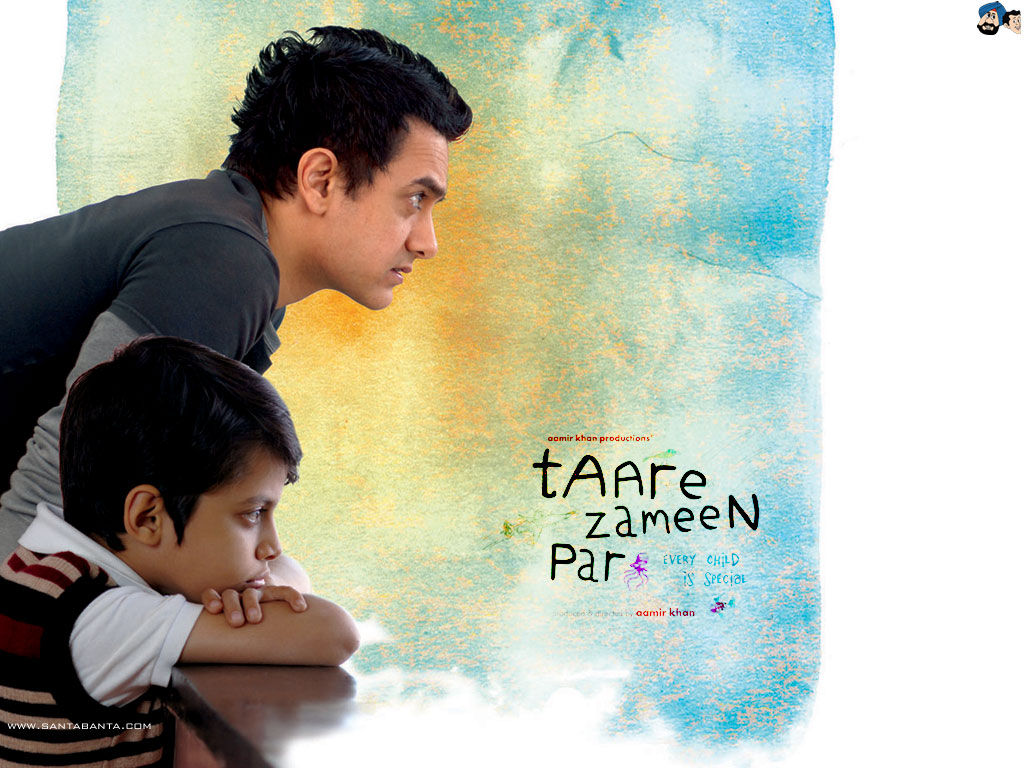
A publicity poster based on a scene from the film. Khan knew immediately when setting up the shot—part of the montage that details Ishaan's tutoring by Nikumbh—that it would be the "key art of the film". Khan noted, "This one shot tells you the entire story."[1]
Like Stars on Earth
Directed by
Produced by
Aamir Khan
Written by
Amole Gupte
Starring
Music by
Cinematography
Setu
Edited by
Distributed by
Release dates
·         21 December 2007
Running time
164 minutes[2]
Country
India
Language
Budget
120 million(US$1.8 million)[3]
Box office
889 million(US$13 million)[4]
STORY
Ishaan Nandkishore Awasthi (Darsheel safary) is an eight-year-old boy who dislikes school and fails every test or exam. He finds all subjects difficult, and is belittled and berated by his teachers and classmates. But Ishaan's internal world is rich with wonders that he is unable to convey to others, magical lands filled with colour and animated animals. He is an artist whose talent is unrecognised.
After receiving a particularly poor academic report, Ishaan's parents send him to a boarding school. There he sinks into a state of fear and depression, despite being befriended by Rajan (Tanay Chheda) physically disabled and one of the top students in his class.
Ishaan's situation changes when a new art teacher, Ram Shankar Nikumbh (Aamir Khan), joins the school's faculty. An instructor at the Tulips School for young children with developmental disabilities, Nikumbh's teaching style is markedly different from that of his strict predecessor, and he quickly observes that Ishaan is unhappy and contributes little to class activities. He reviews Ishaan's work and concludes that his academic shortcomings are indicative of dyslexia.
On his day off, Nikumbh sets off to Mumbai, to visit Ishaan's parents. Nikumbh is surprised to learn that Ishaan is passionate about painting, and shows great talent in art. Nikumbh returns, and subsequently brings up the topic of dyslexia in class, and offers a list of famous people who were dyslexic. Later, Nikumbh reveals to Ishaan, that he too is a dyslexic and faced problems similar to Ishaan. Nikumbh then visits the school's principal and obtains his permission to become Ishaan's tutor. He attempts to improve Ishaan's reading and writing by using remedial techniques developed by dyslexia specialists; Ishaan soon develops an interest in language and mathematics, and his grades improve.When Ishaan's parents meet his teachers on the last day of school they are left speechless by the transformation they see in him. Overcome with emotion, Ishaan's father thanks Nikumbh. As Ishaan is getting into the car to leave with his parents for summer vacations, he turns around and runs toward Nikumbh. The film ends with a freeze frame shot of Nikumbh tossing Ishaan into the air.
Difficulties faced by ISHAN

Ishaan Awasthi is an eight-year-old whose world is filled with wonders that no one else seems to appreciate; colours, fish, dogs and kites are just not important in the world of adults, who are much more interested in things like homework, marks and neatness. And Ishaan just cannot seem to get anything right in class. When he gets into far more trouble than his parents can handle, he is packed off to a boarding school to 'be disciplined'. Things are no different at his new school, and Ishaan has to contend with the added trauma of separation from his family.

Movie’s message
Tare zameen par help me to learn that each child is special and is born with some talent.Ssmeone have such problems as shown in thjs movie. But they might all not have been dyslexic, some might have been... some might have had other issues. We basically have to try to understand the problem, instead of being stubborn about it and pressurizing the person involved. In a broader sense, we should try to understand, feel and recognise what people might be going through, instead of just being judgmental and bigoted. If we just make an effort to educate ourselves of the issues, instead of putting them down without even thinking, it would be a real help in most situations
Role of parents and society

 Role of parents to deal a special child
According to a research study by Ronald Ferguson, "Nearly half of a child's achievement in school can be accounted for by factors outside the school, including parent support." Consequently, the most important support any child can receive comes from the parents.
When dealing with oppositional parents, it may be beneficial to consider the role of parents in their child's education in order to guide them in an appropriate direction.
The role of parents may be divided into three main categories: (1) the parent's role in showing support for their child's education, (2) the parent's role in making their home a good place for learning, and (3) the parent's role in helping with homework.
Role of teacher to deal a special child
The true teacher is he who can immediately come down to the level of the student, transfer his soul to the students soul and see through and understand through his mind. Such a teacher can really teach and none else-- Swami Vivekananda
It shall be our primary duty to understand them, to be just, courteous, to promote a spirit of enquiry, fellowship and joy in them, not to do or say anything that would undermine their personality, not to exploit them for personal interests and to set before them a high standard of character, discipline and personality.

Duties of a teacher:

              Tell students about purpose of education in the Schools.
              Build one to one relationship with students        
              Take-up Personality Development Programmes.
              Know everything about your students
              Make students aware of realities of life
              Inspire students to face problems with braveness
              Apprise students about probable dangers and hazards in and around school campus
              Provide your students psychological therapy
Role of peer group to deal a special child:

Peer group

A peer group is both a social group and a primary group of people who have similar interests, age, background, or social status. The members of this group are likely to influence the person’s beliefs and behaviour. Peer groups contain hierarchies and distinct patterns of behavior. 18 year olds are not in a peer group with 14 year olds even though they may be in school together, just as teachers do not share students as a peer group.
Peers serve many important roles in the life of a developing child.  From toddlerhood through adolescence, peers serve to meet the child’s need for acceptance and belonging.  They provide valuable messages regarding the child’s socialization…informing the child, through words and actions, which behaviors are acceptable and which are not.  Peers serve to provide children a source of support in times of difficulty or stress, they share in times of joy and excitement, and they participate in learning activities providing motivation, competition, and companionship.  We cannot ignore the powerful impact of the peer group on a child’s healthy growth, development and socialization.  Listed below is an outline of 4 functions that a peer group plays for a child.
Inclusive Education
According to me INCLUSIVE EDUTION is more effective as;
We all know that every child is unique and different. They have different abilities; learn in different ways, and at different paces. Inclusive, learning-friendly, and barrier-free environments should therefore be created in every school and community throughout the world so that all children will be enabled to develop to their full academic, social, emotional, and physical potentials.
Inclusive education refers to an academic system that allows special education students to become included in mainstream classes alongside their peers. Benefits of inclusive education include an opportunity for special-needs students to learn team work skills while heightening their sense of belonging in the school community.